Nemesis
AI-driven botnets, pre-strike cyber-attacks against critical infrastructure, traceless ransomware campaigns.
Offensive cyber weapons are critical for next-generation warfare. Nemesis was designed by cyber experts for operators. Nemesis has been influenced by high-ranking operators, proving its intent and capabilities to become one of the country's finest weapons in modern warfare.
“Deterrence in cyberspace doesn't exist without credible, lawful, and operational offensive cyber capabilities. Defense alone is not sufficient.”
- Status
- In development
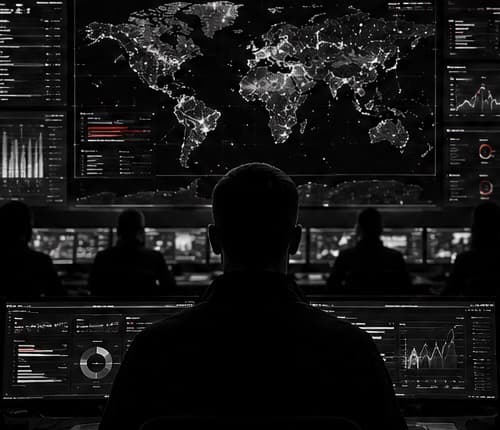
- AI-orchestrated mission planning from reconnaissance to Command and Control(C2)
- Coordinates thousands of specialized AI agents through a unified command layer
- Provides transparent, operator-approved execution with complete auditability
- Operates securely inside government and enterprise-controlled infrastructure
Nemesis acts as a strategic co-pilot for cyber operations. It rapidly gathers, organizes, and synthesizes vast amounts of publicly available information to build a clear picture of potential targets, their ecosystems, and their vulnerabilities. From there, it designs detection-less payload malware & attack plan, ready for operational execution.
What traditionally required weeks of analyst effort can be accomplished in a fraction of the time. This enables red teams to move faster, decide with better information, and achieve operational advantage against constantly growing adversarial threats. Its key differentiator is scaled expertise under explicit control. By orchestrating specialized AI-driven capabilities and agents behind the scenes, Nemesis brings the equivalent of hundreds of expert teams from intelligence analysts, planners, and operators into a single unified system, while a human operator retains oversight and authority at every consequential decision point.
The result is a streamlined, end-to-end capability that moves from discovery to operational control of target systems with minimal friction. For organizations operating under tight timelines or resource constraints, this represents a force-multiplying capability that enhances mission effectiveness without requiring proportional increases in staffing or overhead.